

How to Choose Sheets for Your Vacation Rentals: A Buying Guide for Professional Property Managers
Sheets are the most-touched textile in any property you manage. A guest spends seven or eight hours a night in direct contact with them. Yet most operators choose sheets the same way a homeowner does: by reading retail reviews, comparing thread counts and buying whatever feels softest out of the package.
That approach works for a home. It fails in a rental program, where sheets face commercial laundering, constant turnover, stain treatment and the scrutiny of a new guest every few nights.
Building a sheeting program comes down to four decisions, made in order: the material, the format, the PAR level and how you communicate the program to your owners. This guide walks through each one.
Start with the right question: cost per stay, not cost per sheet
The biggest sheeting mistake isn't a fabric choice. It's a math choice.
A retail queen flat sheet that costs $28 and survives around 50 commercial washes is more expensive than a hospitality-grade queen flat sheet that costs $17 and survives over 100. The acquisition price tells you almost nothing. The cost per occupied night tells you everything.
Retail sheets, including the highly rated ones from Amazon and Target, are optimized for initial softness, consumer reviews and gentle home laundering. They typically last around 50 washes before they pill, fade, shrink or thin out under commercial conditions. Hospitality-grade sheets are engineered for high-frequency washing in industrial machines with hot water and stronger chemicals, and they last over 100 washes. That's the core economic difference: double the wash life, often at a lower unit price.
Retail sheets carry a second hidden cost: they're seasonal. The pattern you bought in spring disappears from shelves by fall, which makes matched replacement nearly impossible. Hospitality-grade sheets are built with reinforced seams, denser weaves and higher tensile strength, and they're evergreen, so the sheets you buy next year match the sheets on the bed today.
The action item: before your next linen order, calculate cost per expected wash cycle, not cost per unit. The "expensive" hospitality sheet usually wins.
Decision one: the material
The thread count myth
Thread count measures the number of vertical and horizontal threads woven into one square inch of fabric. Retail marketing has trained consumers to believe higher is always better. Hotels know better.
Most hotels use sheets in the 200 to 300 thread count range, and hospitality-grade sheeting does not go above 320. That ceiling isn't a cost compromise. It's a durability decision. Hospitality sheeting prioritizes single-ply weaves, where each thread is one strong, continuous yarn, because single ply delivers maximum durability through commercial laundering. Honest single-ply construction simply doesn't produce the inflated numbers you see on retail packaging.
So how do retail brands hit 600, 800 or 1,000? Creative math. Manufacturers twist two or three thinner yarns together into a single thread, then count each strand separately. A 2-ply, 300 thread count fabric gets marketed as 600 thread count. The individual yarns are thinner and weaker, the fabric is heavier and slower to dry, and the number on the package tells you nothing about quality.
What to buy instead: single-ply construction in the 200 to 300 thread count range. When you see a thread count above 320, you're not looking at a better sheet. You're looking at marketing.
Match the fiber to your tier
There is no single correct fabric. There is a correct fabric for each quality tier in your portfolio, and the hotel industry has already done the testing for you.
| Property tier | Recommended sheeting |
|---|---|
| Economy | 100% microfiber or T200 cotton/poly blend |
| Midscale | T250 cotton/poly blend |
| Premium | T300 cotton-rich blend |
| Luxury | 100% T300 extra-long staple cotton |
For most vacation rental portfolios, a 60/40 cotton/poly blend is the workhorse. The cotton provides breathability and a soft hand. The polyester adds strength, lifts stains more readily, resists wrinkling and withstands high-temperature washing and drying. It also reduces ironing, which is real labor savings at scale.
Reserve 100% cotton for your true premium and luxury homes, where the nightly rate justifies the higher replacement frequency and more demanding care. When you do buy cotton, staple length matters more than thread count. Staple refers to the length of the individual cotton fibers. Longer staple fibers produce softer, stronger fabric with fewer joints. Short staple cotton pills, roughens and wears out quickly, no matter what the thread count says.
What is microfiber?
Microfiber is a fully synthetic fabric woven from extremely fine polyester fibers, far finer than a strand of cotton. That construction is what gives it its strengths: it's budget-friendly, soft to the touch, wrinkle-resistant and quick-drying, which is why it anchors the economy tier. The tradeoffs are real, though, and one matters more than the rest: microfiber sleeps hot. Because the fabric isn't breathable, it traps body heat and holds it against the guest through the night, the antithesis of a good night's sleep. It also traps body oils and builds up residue over time, it pills, and it generates static. Reserve it for your economy tier with eyes open, and don't put it on a bed where the nightly rate promises a great night's sleep.
One spec note that trips up buyers: thread count doesn't apply to microfiber. Microfiber quality is measured in GSM, or grams per square meter, which indicates the fabric's weight, density and durability. A 90 GSM sheet is lightweight and more prone to tearing. A 120 GSM sheet is heavier and holds up considerably better. If you're buying microfiber for economy homes, buy by GSM, not by the adjectives on the packaging.
Weave: percale vs sateen
Weave is the pattern in which yarns interlace, and it determines how a sheet feels far more than thread count does. Two weaves dominate hospitality sheeting, and operators should understand both before buying.
Percale is a tight one-over, one-under weave. It feels cool, crisp and breathable against the skin. It's the classic hotel sheet feel, and it performs well in warm climates and for guests who sleep hot.
Sateen uses a four-over, one-under weave that exposes more yarn on the surface, creating a silky, smooth, slightly lustrous finish with a touch more weight and warmth. In vacation rentals, sateen is the bestseller. Guests in a home setting respond to that softer, more inviting hand, and sateen has a subtle drape that photographs and presents beautifully on a made bed.
So which should you buy? Let the guest experience you're selling decide. Beach and warm-weather properties, and portfolios built around that crisp hotel feel, are well served by percale. Mountain homes, cooler climates and properties positioned around comfort and warmth tend to favor sateen, and guest purchasing behavior backs that up. Either weave performs in commercial laundering when you buy hospitality-grade construction. The mistake isn't choosing one over the other. It's mixing both across a portfolio and losing a defined standard, or buying a retail version of either that breaks down after 50 washes.
Don't overlook wrinkle resistance
Every minute a housekeeper spends smoothing or ironing a wrinkled flat sheet is a minute added to your turnover time, multiplied across every bed in every property. Cotton/poly blends come out of the dryer largely wrinkle-free. Pure cotton requires prompt removal from the dryer and often pressing to look right in photos and in person. If your team is stretched on changeover days, wrinkle resistance belongs on your spec sheet next to thread count.
Decision two: the format. Standard sheeting or triple sheeting?
Once you've chosen the material, decide how you'll make the bed. This choice changes what you buy, how housekeeping works and how the bed presents to the guest.
Standard sheeting is what most operators run today: a fitted sheet, a flat sheet, then a comforter or a duvet with a cover.
Triple sheeting is how hotels make beds. The bed is layered with three flat sheets, with the blanket or duvet sandwiched between the middle and top sheets:
- Layer one: the bottom sheet (flat or fitted) on the mattress
- Layer two: a flat sheet placed on top of the bottom sheet
- Warmth layer: a blanket or comforter
- Layer three: a flat sheet placed on top of the warmth layer
The result is that every fabric surface touching the guest is a sheet that gets stripped and laundered at every turnover. Housekeeping swaps flat sheets instead of wrestling duvet inserts in and out of covers, and the finished bed has that tightly layered, unmistakably hotel look.
The top sheet question
One format detail deserves its own discussion: triple sheeting versus a full duvet and cover. It's one of the most debated choices in short-term rentals, and getting it wrong is a fast way to make a guest uneasy about the bed they're sleeping in.
Length of stay should drive the decision, because the real issue is the comforter underneath. Triple sheeting works in hotels, where housekeeping makes the bed every day or every other day and a guest never has to think about what's beneath the top sheet. In a vacation rental it's a harder sell. The comforter sits exposed at the foot of the bed, and guests get grossed out by an exposed comforter they don't believe gets washed between stays. On a longer stay that doubt has days to build.
For longer stays, guests strongly prefer a full duvet with a cover. The cover is the part that touches them, they know it gets stripped and laundered between every stay, and they never have to touch an exposed comforter at all. That trust is worth more than the made-bed look of a triple-sheeted setup.
The operator's answer: match the format to your typical stay. For short stays with frequent housekeeping, triple sheeting delivers the hotel look and a fully launderable bed. For the longer stays most vacation rentals run, use a duvet with a washable cover that's laundered every stay. It's the setup guests trust, and trust is what protects your reviews. Whatever you choose, apply it consistently across the portfolio so housekeeping works to one standard.
The format decision also changes your purchasing math. A triple-sheeted bed needs more flat sheets per set than a standard bed, which flows directly into the next decision: how many sets you stock.
Decision three: the PAR level
PAR stands for Periodic Automatic Replenishment, sometimes expressed as Per Available Room. It's the hotel industry's standard for how many complete sets of linens you keep per bed.
The hospitality standard is 3 PAR:
- One in use on the bed
- One in the laundry
- One in inventory as backup
A standard set for a king, queen or full bed means one flat sheet, one fitted sheet and two pillowcases. A twin set is one flat, one fitted and one pillowcase. If you triple sheet, define your set accordingly so every bed always has a complete, matched rotation.
PAR levels matter for three reasons. They prevent shortages and emergency runs to the store. They support efficient scheduling of laundry and turnovers. And they make reordering and budgeting predictable instead of reactive. Operators who run below 3 PAR aren't saving money. They're one stained sheet away from a delayed check-in.
Stocking a large portfolio at 3 PAR across multiple bed sizes and formats is a significant line item, and it shouldn't live in a napkin estimate. Inhaven offers a proprietary linen calculator that helps property managers model costs by PAR level and calculate the fees needed to support the program.
A detail that pays for itself: color-coded hemstitching
Hospitality-grade sheets solve a problem every housekeeper knows: telling a king flat sheet from a queen flat sheet in a stack of folded white linens. Hospitality suppliers offer color-coded hemstitching, a thin colored stitch line along the hem that corresponds to size. Your team identifies the right sheet at a glance, without unfolding anything. It's a small detail that saves real time on every single turnover.
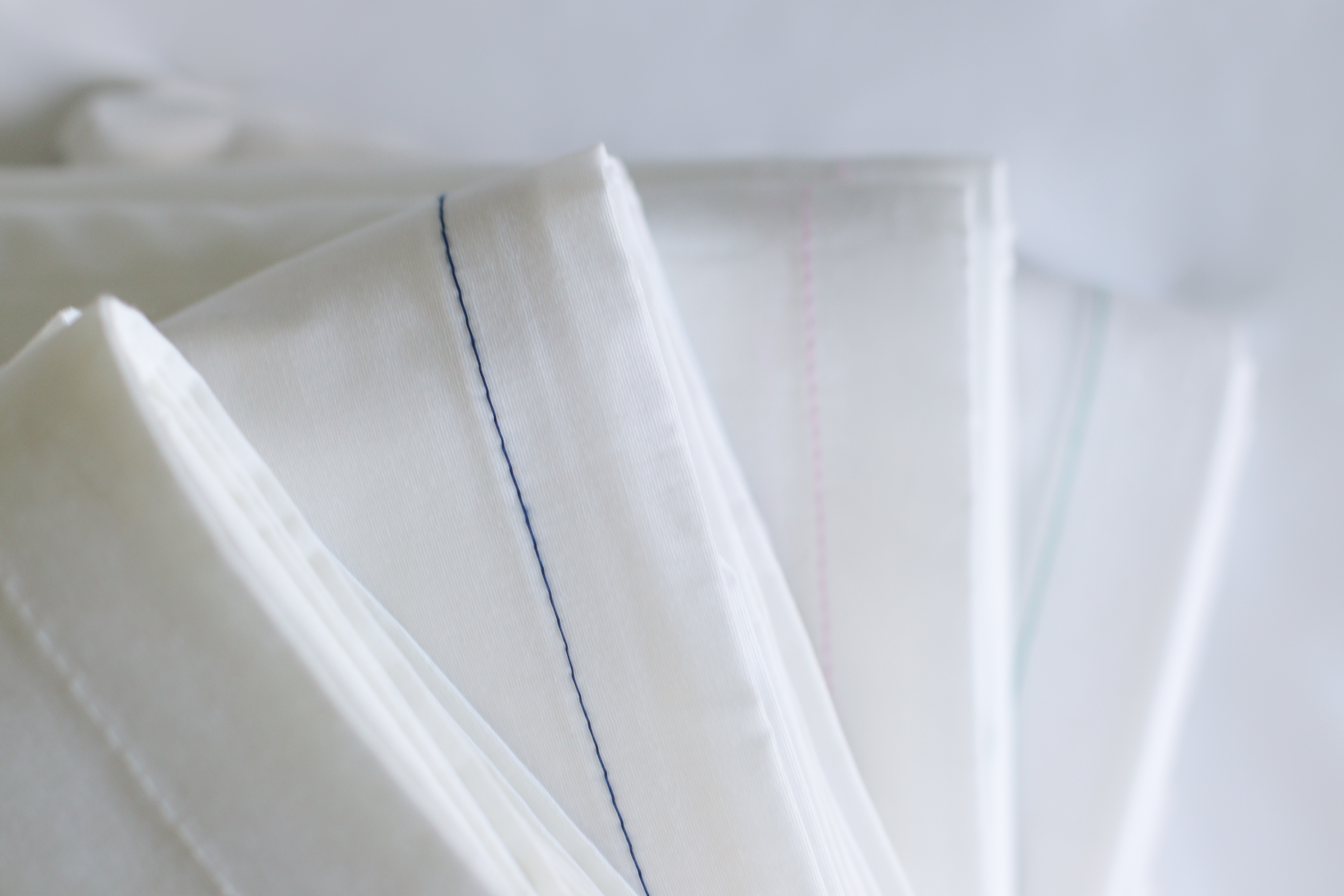
Standardize on white, standardized sizes across the portfolio wherever possible. Any set works in any property, sorting at the laundry gets simpler and replacement orders become predictable.
Decision four: communicating the program to your owners
A linen program isn't just an operations decision. It's an owner relations decision, and how you structure and present it determines whether owners see it as a cost or as an investment in their asset.
There are three common cost structures:
- 100% property manager: you absorb the linen cost and recover it through your fee structure
- Pro-rata split: you and the homeowner share the cost
- 100% homeowner: the owner funds the linens for their property, typically through a bi-annual or annual assessment
Operators recover linen costs in different places: some build them into housekeeping fees alongside labor, amenities, laundry and cleaning supplies, some into resort or cleaning fees, and some into the management fee itself. There's no single right answer, but there is a right principle: the structure should be explicit, defensible and tied to the value owners receive. Fresh, hospitality-grade linens protect reviews, protect nightly rates and protect the owner's asset. Framed that way, a well-run linen program isn't a cost center. It can be a profit center.
Owner communication deserves more depth than one section can give it, including how to present the program, handle objections and run the annual assessment conversation. We'll cover that in a dedicated guide.
Protect the investment with proper laundering
Most premature linen replacement comes from improper laundering, not guest use. Two rules apply to everything, and then care diverges by material.
Rule one: never wash sheets with towels. Towels shed lint and their looped terry fabric abrades sheeting in the wash, leaving pilling on the sheet surface. Sort sheets and towels into separate loads, every time. Build it into your laundry SOP and your vendor agreement.
Rule two: match the care to the material. Washing the wrong way destroys good linens fast.
100% cotton is the most forgiving with heat. Wash in warm or hot water up to 140 degrees with commercial detergent. Avoid chlorine bleach, which breaks down cotton fibers; use oxygen bleach if needed. Dry on medium to high heat and remove promptly to reduce wrinkling. Pre-treat stains as soon as possible with an enzyme-based stain remover, letting it sit 10 to 15 minutes before washing.
Cotton/poly blends need moderation. Wash in warm water up to 120 degrees with mild detergent and minimal bleach. Dry on low to medium heat, remove promptly and avoid over-drying, which causes shrinkage. Pre-treat stains with a mild stain remover for five to ten minutes and avoid harsh scrubbing that damages fibers.
100% microfiber demands the most caution, for one critical reason: microfiber is a synthetic, and it melts with heat. Heat doesn't just shorten its life, it destroys the very thing you bought microfiber for. Wash or dry it hot and the fibers distort, and the wrinkle-free, quick-drying quality that makes microfiber worth running is gone for good, leaving sheets that wrinkle worse than the cotton you were trying to avoid. So keep it cool: wash in cold to warm water, 105 degrees maximum, with gentle detergent and no fabric softener. Dry on low or no heat, with air drying preferred, and remove immediately to avoid static. Never use dryer sheets, and don't wash microfiber with natural fibers, which it attracts as lint. Use water-based stain removers only; oil-based products damage the fibers.
If you run economy properties on microfiber and premium properties on cotton, your laundry partner needs to know which is which. The cheapest sheet you'll ever own is the one you don't have to replace this year.
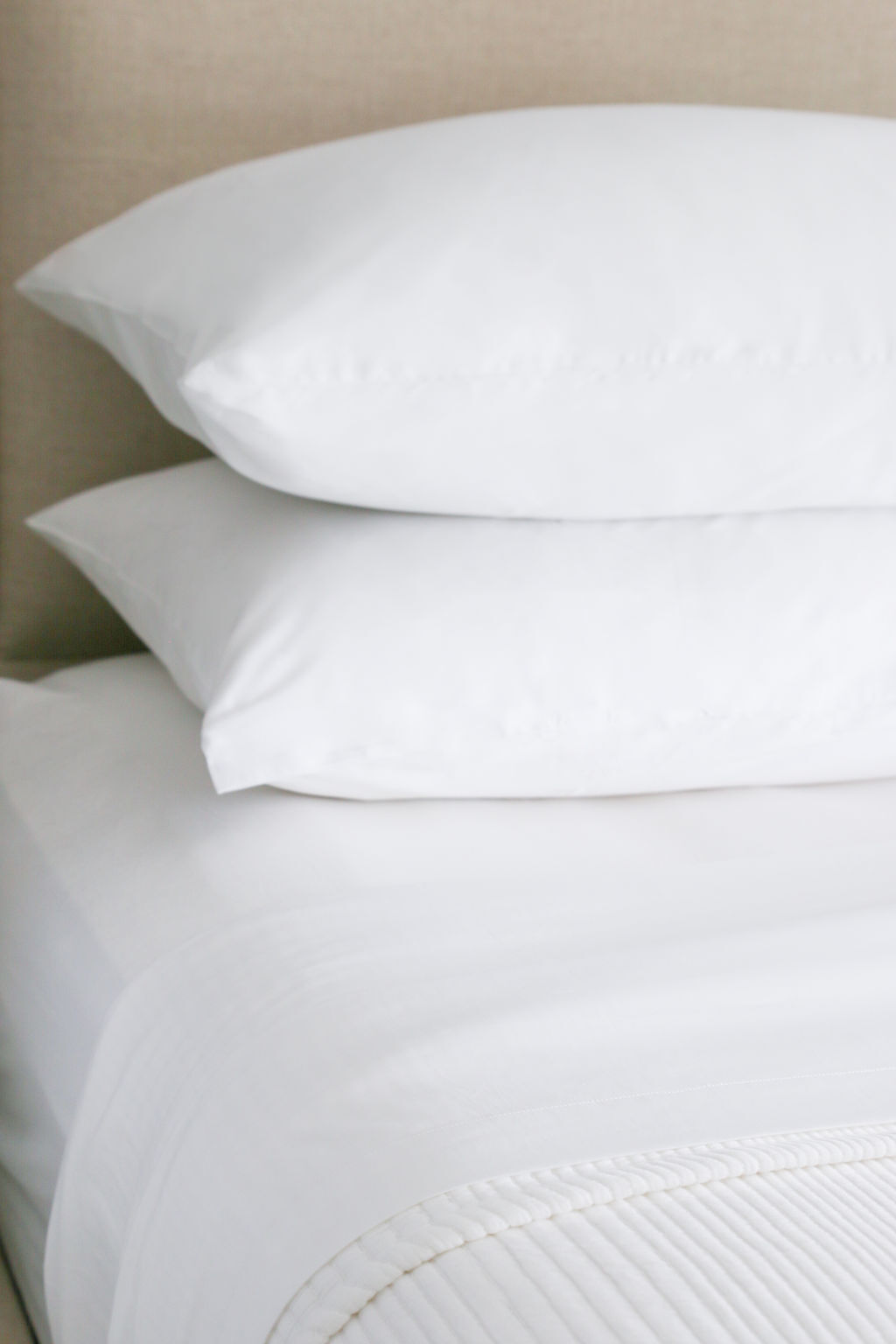
The spec sheet to buy against
If you take one thing from this guide, take this checklist:
- Fiber: 60/40 cotton/poly for most homes, extra-long staple 100% cotton for luxury
- Weave: sateen for most vacation rental settings, percale for a crisp hotel feel, one standard per portfolio
- Thread count: 200 to 300, single ply, never above 320 (for microfiber, judge by GSM instead, with 120 GSM over 90)
- Durability: hospitality grade rated for 100+ commercial washes, not retail's roughly 50
- Availability: evergreen, not seasonal
- Format: standard or triple sheeting, decided before you order so your sets match your make
- Color: standardized white across the entire portfolio, so any set works in any property
- Identification: color-coded hemstitching by size
- Inventory: standardized white sets stocked at 3 PAR per bed (one in use, one in the laundry, one in backup)
- Care: sheets and towels washed separately, laundering specs matched to material, microfiber kept away from heat
- Program: a defined cost structure communicated clearly to owners
- Math: evaluated on cost per stay, not cost per sheet
Guests rarely mention sheets when they're right. They always mention them when they're wrong. Buy like a hotel, and your sheets become one less thing standing between your properties and five-star reviews.