

How to Choose Towels for Your Vacation Rentals: A Buying Guide for Professional Property Managers
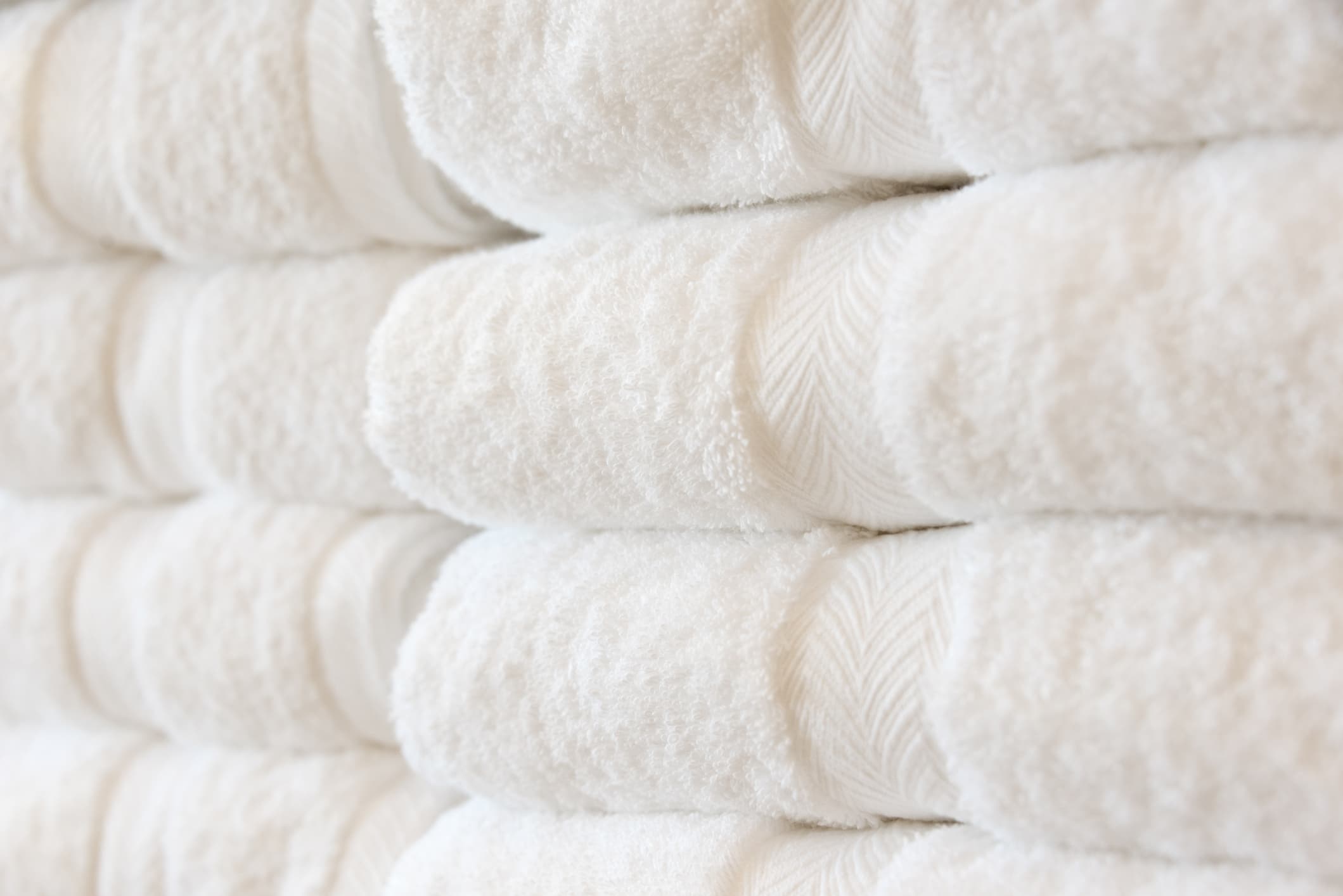
A guest forms an opinion about your towels in about three seconds: the moment they pick one up off the rack. Thin, scratchy or dingy, and the bathroom feels like a budget motel no matter what the nightly rate says. Thick, white and soft, and the property reads like a hotel.
Most operators buy towels the way they buy sheets: from retail, by the reviews, in whatever color matches the bathroom. And just like sheets, retail towels are built for a home with two people and a weekly wash, not a rental program with a new set of guests every few nights.
This guide covers how to buy towels the way hotels do: by weight, construction, border and color, then how to stock them, protect them and keep your guests safe.
Why hospitality grade: twice the life, none of the hourglass
The economics mirror sheeting. Retail towels last around 50 commercial washes. Hospitality-grade towels last 100 or more, roughly twice the life, because they're engineered for industrial machines, hot water and stronger chemicals.
But towels have a failure mode sheets don't, and it's worth understanding before you buy.
Retail towels shrink. Worse, they shrink unevenly. The flat woven border at each end of a towel shrinks at a different rate than the looped terry body, and after repeated commercial washing the towel pulls into an hourglass shape: pinched in the middle, flared at the ends. An hourglassed towel looks worn and cheap on the rack even when it's freshly laundered. Hospitality-grade towels are manufactured to prevent this. The border and the base are engineered to shrink together, so the towel stays rectangular and presents properly wash after wash.
The action item: the same cost-per-stay math from your sheeting program applies here. Double the wash life, a towel that holds its shape, and evergreen availability so replacements always match.

Learn the hospitality weight language: pounds per dozen
Here's where vacation rental operators coming from retail get lost. Retail towels are marketed in GSM. Hospitality towels are measured in pounds per dozen. If you're going to buy like a hotel, you need to speak both.
GSM, or grams per square meter, measures the density of the fabric itself: how much a square meter of the terry weighs. It's the number on retail packaging, where 600 GSM gets marketed as "luxury."
Pounds per dozen measures what twelve finished towels actually weigh. It's the number hospitality suppliers quote, and it's the more practical one for an operator, because it reflects the real towel in your housekeeper's hands, including its size.
The translation between the two depends on towel dimensions, but here's a working anchor: a standard 27 by 54 inch bath towel at 15 pounds per dozen weighs about 1.25 pounds, which works out to roughly 600 GSM. So that 600 GSM retail towel you've been buying corresponds to roughly a 15 pound per dozen hospitality towel, the premium tier, often at a fraction of the price.
The hospitality weight ranges:
| Weight class | Pounds per dozen | Typical use |
|---|---|---|
| Lightweight | 5 to 10 lb | Motels, gyms, athletic clubs |
| Medium weight | 10 to 15 lb | Mid-range to upscale hotels, spas, resorts |
| Heavy weight | 15 to 20 lb | Luxury hotels, spas, resorts |
Heavier means more cotton, more absorbency and a plusher hand. It also means longer drying times and more weight per laundry load, which is why the heaviest towels belong in your luxury homes, not your whole portfolio.
Construction: twist is the texture
Two towels at the same weight can feel completely different, and twist is why. Twist refers to how tightly the cotton yarns are spun before they're looped into terry.
Standard twist is the most common towel type. The tightly twisted yarns are durable and affordable, but they have fewer air gaps and less surface area, so the towel feels less plush and doesn't dry the guest as quickly.
Low twist and zero twist yarns are spun loosely or not at all, leaving open loops full of air gaps and surface area. The result is a softer, more luxurious feel, better absorbency and quicker drying. The catch: zero twist construction requires long, high-quality cotton fibers to hold together, which is why it costs more and sits at the top of the tier table.
Two more terms worth knowing when you read a spec sheet. Ring spun cotton is spun around a ring so short and long fibers twist together into a smoother, softer, stronger yarn. Combed cotton goes through an extra step that removes short and broken fibers, producing a softer and more durable fabric. Both are marks of better construction.
The border: choose a classic dobby
Every towel has a flat woven band near each end, and that band is a real purchasing decision.
CAM border towels have a plain, minimal band. They're the budget option and they look it. Fine for economy properties, gyms and pool towels.
Dobby border towels have a woven decorative band, and this is the hospitality standard for guest-facing towels. Dobby borders come in many designs, from a simple clean band to elaborate patterns like checkers, stripes and piano borders.
Here's the opinionated part: choose a classic, simple dobby border, not a decorative one. A distinctive piano border or patterned band might look elegant in a catalog, but it locks you in. When that style is discontinued or backordered, your replacement towels won't match what's on the rack, and a mismatched towel set reads as sloppy. A classic dobby border is easy to swap, easy to match across suppliers and timeless in any bathroom. In towels, boring is a feature.
The tier table
| Property tier | Recommended towel |
|---|---|
| Economy | CAM border, cotton/poly blend |
| Midscale | Dobby border, 14 lb per dozen, 100% cotton |
| Premium | Dobby border, 15 lb per dozen, 100% cotton, low twist |
| Luxury | Dobby border, 16 to 18 lb per dozen, 100% cotton, zero twist |
Note that 100% cotton takes over from the midscale tier up. Cotton is the most absorbent and breathable fiber, and for the towel a guest dries their face with, absorbency is the whole job. Cotton/poly blends and microfiber still have a place: blends for economy programs and pool towels, microfiber for cleaning cloths, but guest-facing bath towels should be cotton.
Choose white. Every time.
Hotels figured this out decades ago, and the reasoning holds even more strongly for vacation rentals.
White shows everything, which sounds like a flaw and is actually the point: a stain can't hide, so it gets treated or the towel gets pulled. White is bleach friendly, so commercial laundering can fully sanitize and restore it. White streamlines inventory, because every white towel works in every bathroom in every property, which simplifies sorting, stocking and replacement. And white is what guests trust. It evokes a spa, it's psychologically calming, and guests perceive white as cleaner than any color. A colored towel might be just as sanitary, but it can't prove it the way a bright white one can.
Bath mats: a towel, folded, every time
Bath mats deserve their own section because operators get two things wrong with them.
First, the format. Buy bath mats in towel format, the launderable terry rectangle, not rubber-backed rugs. A towel-format mat goes through the same commercial wash as everything else and gets replaced on the same cycle.
Second, the presentation, and this one is about liability. Never stage a bath mat laid out on the floor. A mat lying on the floor at check-in is a trip hazard, and if a guest trips on it, that's a liability exposure for your business. This is exactly why hotels always present the bath mat folded, on the tub edge or the towel rack, and let the guest lay it out themselves when they shower. The guest placing the mat is the guest accepting it. Store them folded, stage them folded, and put it in your housekeeping checklist.
Makeup washcloths: cheap insurance for white towels
The single most common stain on white towels isn't dirt. It's makeup, and makeup remover, foundation and mascara are brutal on white terry.
The fix costs almost nothing: stock dedicated makeup washcloths, typically dark-colored cloths labeled for makeup removal, in every bathroom. Guests don't ruin white towels out of malice; they use what's there. Give them the right cloth and your white towels stay white. Many operators use dark microfiber cloths for this, which handle makeup well and are obviously distinct from the bath linens.
Stocking: PAR levels for the bath
Like sheeting, towels run on a 3 PAR standard (Periodic Automatic Replenishment): one set in use, one in the laundry, one in backup. The difference is what makes up a set, because bath PAR is driven by guest count and bathroom count, not bed count.
One PAR for the bath:
- Bath towels: 1 to 2 per guest
- Washcloths: 1 to 2 per guest
- Hand towels: 1 to 2 per bathroom
- Bath mats: 1 per bathroom, with one exception: if a bathroom has both a shower and a separate tub, stock 2, because there are two places for a guest to step out
- Pool towels (where applicable): 1 per occupant
Multiply each by three for your full PAR stock. An eight-guest, three-bath home needs a meaningfully bigger towel inventory than its bed count suggests, and this is where modeling the numbers matters before you order.
Inhaven's linen calculator handles towel PAR math the same way it handles sheeting, by property, by tier and by fee structure, so an eight-guest, three-bath home gets stocked from real numbers instead of a napkin estimate.
Care: protect the absorbency
Towel care has its own rules, and breaking them shortens towel life and ruins the one thing a towel is for.
Wash towels separately from sheets. Towels shed lint and their terry loops abrade sheeting, leaving pilling on sheet fabric. Separate loads, every time.
Skip the fabric softener. Softener coats the cotton fibers and reduces absorbency, which defeats the purpose of the towel. If towels feel stiff, the fix is proper drying, not softener.
Follow cotton care. Wash in warm or hot water up to 140 degrees with commercial detergent. White towels tolerate bleach, which is part of why you bought white, but prefer oxygen bleach for routine brightening since chlorine bleach degrades cotton fibers over time. Pre-treat stains immediately with an enzyme-based remover, and use a hydrogen peroxide-based cleaner for makeup, blood or wine. Blot, never rub.
Respect the machine. Don't overload the washer or dryer, unfold linens before loading, and never over-dry. Store towels in a cool, dry, dark place.

The spec sheet to buy against
If you take one thing from this guide, take this checklist:
- Weight: measured in pounds per dozen, 14 lb midscale, 15 lb premium, 16 to 18 lb luxury (roughly 600 GSM in retail terms for a 15 lb bath towel)
- Fiber: 100% cotton for guest-facing towels, blends for economy and pool, microfiber for cleaning cloths only
- Twist: standard for economy, low twist for premium, zero twist for luxury
- Construction: ring spun, combed cotton where the spec offers it
- Border: classic dobby, never a decorative pattern you can't reorder
- Color: white, always, because it bleaches, matches everything and reads as clean
- Durability: hospitality grade rated for 100+ washes, engineered against shrinkage and hourglassing
- Bath mats: towel format, stored and staged folded, two in any bathroom with both a shower and a tub
- Protection: dark makeup washcloths in every bathroom
- Inventory: 3 PAR built on guest count and bathroom count, not bed count
- Care: towels washed separately from sheets, no fabric softener, enzyme pre-treatment for stains
A guest will forgive a lot in a vacation rental. A thin, gray, misshapen towel is rarely one of those things. Buy by the pound, buy it white, and buy it once instead of twice.