
How to Choose Dinnerware for Your Vacation Rentals: A Buying Guide for Professional Property Managers
16th Jun 2026
A broken dinner plate seems like a small problem, right up until you go to replace it. The collection has been discontinued, the closest match is a shade off, and now one property has three different plate styles sharing a cabinet. What started as a five-dollar breakage has quietly become an inventory headache.
Most operators don't struggle with picking dinnerware they like. They struggle with managing it across a growing portfolio. The collections that work long term aren't chosen for a trend, a color story, or a designer name. They're chosen for standardization, durability, and the boring but essential question of whether you can still buy the same piece in two years.
Dinnerware is an operational asset, the same as your linens. Treat it that way and it quietly does three jobs at once: it improves the guest experience, simplifies replenishment, and keeps inventory flowing between homes instead of getting stranded one cabinet at a time. Here is how to buy it like a professional.
Why dinnerware matters more than operators expect
No guest writes a review praising the dinner plates. But they absolutely notice a kitchen that feels incomplete, mismatched, or worn, and that impression bleeds into how they rate everything else. Dinnerware quietly shapes guest perception, kitchen functionality, and how the property photographs for your listing. It also drives real operational cost: housekeeping time, breakage replacement, and the complexity of tracking what is where. Across dozens or hundreds of homes, small dinnerware decisions compound into a meaningful line item.
Stop managing one property at a time
The most common mistake in a growing portfolio is letting every homeowner pick their own dinnerware. It feels accommodating in the moment and creates a slow-motion mess over time. Collections get discontinued. Replacements become a scavenger hunt. Your warehouse has to carry a dozen different styles, none of which can move freely between homes, and your housekeepers lose time sorting out which plates belong where.
Operators who run this well do the opposite. They standardize on one collection across the portfolio, so any plate replenishes from open stock and any piece can be shifted from a quiet property to a busy one without a second thought. The point was never just to buy plates. It was to build a system that scales.
The action item: pick one standard collection per tier and hold the line on it. The goal is a system you can replenish, not a cabinet you have to curate.

Why white wins
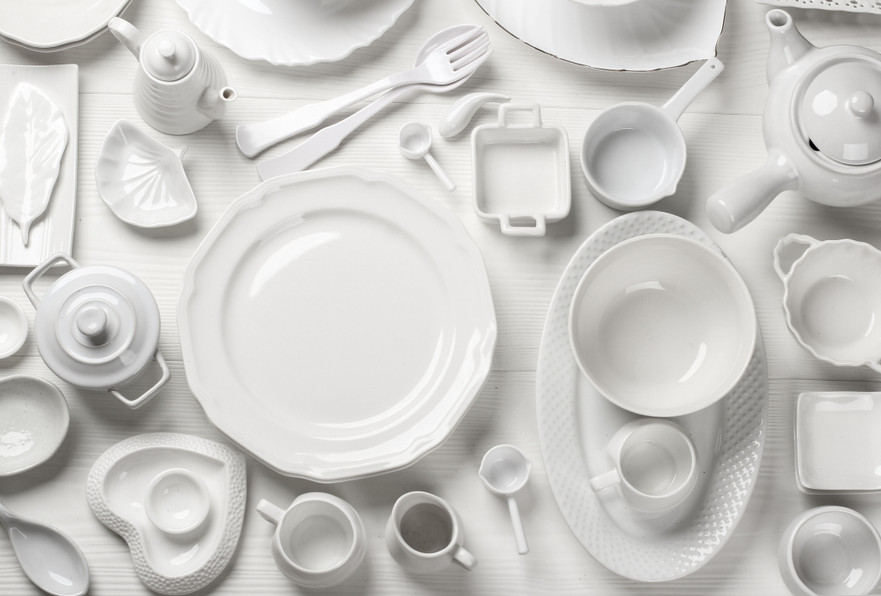
Owners are often drawn to color and pattern, but white dinnerware is the choice that holds up across a portfolio. It works with any kitchen, suits any property style, and photographs clean and bright in listing images. It is easy to replace, and pieces mix freely across homes because there is no pattern to match.
Patterned collections tend to disappoint on the same timeline. They look appealing on day one, then the pattern gets revised or retired and every replacement becomes a compromise. For nearly every operator, simple white is the most practical long-term call.
Hospitality grade vs. retail
Retail dinnerware is built for a household that uses it a few times a week and washes it gently. Hospitality-grade dinnerware is built for constant use, commercial dishwashers, and years of service. The difference shows up as greater durability, better chip resistance, consistent sizing from one order to the next, and open-stock availability.
The quiet advantage matters most: hospitality collections are designed to stay in production for years. That continuity is what makes a single broken plate a five-minute reorder instead of a portfolio-wide replacement project.
Know your materials
Four materials cover almost every vacation rental scenario. Each has a clear best use.
Porcelain
Porcelain is the workhorse and the right default for most properties. It is durable and chip-resistant, lighter in the hand than it looks, timeless in appearance, and widely available. It carries Economy, Midscale, and Premium homes comfortably, which is why it anchors most hospitality programs.
Stoneware
Stoneware has a heavier, more substantial feel and an artisan look that elevates premium and luxury properties. The tradeoffs are physical: it weighs more, which raises shipping and storage costs, and some finishes pick up gray utensil marks over time. Worth it where presentation justifies the handling.
Bone china
Bone china is refined and surprisingly light, with the kind of finish guests associate with fine dining. It belongs in luxury properties where owners are buying an elevated experience and the nightly rate supports more careful handling.
Melamine
Melamine earns its place outdoors, not at the indoor table. It is nearly unbreakable, which makes it ideal for pool areas, patios, outdoor kitchens, and rooftop dining. Use it to protect your real dinnerware from the highest-risk spaces, but keep it out of the main kitchen.
Match the program to your property tier
Not every home needs the same dinnerware, but every home should be on a deliberate standard. Here is how the tiers line up, and the Inhaven collection we would put in each.
| Tier | Material & feel | Best for | Inhaven collection |
|---|---|---|---|
| Economy | Durable porcelain, lightweight | High-turnover and budget-conscious homes that need to take a beating | White porcelain Shop now → |
| Midscale | Porcelain, balanced weight | The core of most vacation rental portfolios | White porcelain Shop now → |
| Premium | Heavyweight porcelain or stoneware, substantial hand | Upscale homes where guests notice the details | White heavyweight stoneware Shop now → |
| Luxury | Bone china, refined and light | Luxury and 5-star positioned properties | White bone china Shop now → |
For every tier, add melamine in the outdoor and poolside collection to protect your indoor dinnerware from the highest-risk spaces.
Not sure which tier fits your portfolio?
Send us your property mix and occupancy and we will spec a dinnerware standard by tier, with open-stock collections you can replenish for years. Free shipping on orders $75+.
Buy open stock, not boxed sets
This is one of the decisions that quietly determines how much time and money your program costs you. Open-stock collections let you buy pieces individually, so you replace a single broken plate, replenish exactly what ran short, and never throw out three good bowls because the fourth cracked. Boxed sets, by contrast, are built for the residential shopper. They look convenient on the shelf and turn painful the moment a piece breaks or the set is discontinued. For a managed portfolio, open stock wins almost every time.
Choose collections that stay in production
A plate that looks great today is worthless to your program if it is gone in eighteen months. Prioritize collections that are widely distributed, hospitality-focused, consistently stocked, and timeless enough that they will not be redesigned out from under you. The best programs are built on pieces you can still reorder year after year, which is exactly what evergreen hospitality lines are designed to deliver.
How much to stock
How much dinnerware a property needs scales with its tier and its occupancy. These are the standards we recommend at Inhaven, expressed as a multiple of the home's guest count.
| Item | Economy | Midscale | Premium | Luxury |
|---|---|---|---|---|
| Dinner Plates | 1.5x Occupancy | 2x Occupancy | 2x Occupancy | 2x Occupancy |
| Salad Plates | — | 2x Occupancy | 2x Occupancy | 2x Occupancy |
| Soup Bowls | — | 2x Occupancy | 2x Occupancy | 2x Occupancy |
| Cereal Bowls | 1.5x Occupancy | 2x Occupancy | 2x Occupancy | 2x Occupancy |
| Mugs | 1.5x Occupancy | 2x Occupancy | 2x Occupancy | 2x Occupancy |
| Flatware Sets | 1.5x Occupancy | 2x Occupancy | 2x Occupancy | 2x Occupancy |
| Dessert/Bread Plates | — | — | — | 2x Occupancy |
| Serving Platters | — | 1 | 2 | 3 |
| Serving Bowls | — | 1 | 2 | 3 |
| Children's Dinnerware Sets | — | — | 2 | 4 |
In practice, an eight-guest midscale home lands at roughly:
- 16 dinner plates, 16 salad plates
- 16 soup bowls, 16 cereal bowls
- 16 mugs
- 16 flatware settings
Building in that cushion above guest count is what absorbs breakage, tight turnovers, and the occasional group that cooks a real meal.
Our inventory calculator sizes dinnerware the same way it sizes linens, by occupancy and tier across your whole portfolio, so your opening order is built on real numbers. Reach out to info@inhaven.com to get started.
A word on chip-free warranties
Chip-resistant and chip-replacement programs can be genuinely useful, especially for higher-end properties or large portfolios where breakage adds up. Just weigh them against the things that actually keep a program running: long-term availability, ease of replacement, open-stock purchasing, and overall cost of ownership. A warranty softens the cost of a broken plate. It does nothing for a collection that no longer exists.
Treat dinnerware like a program, not a purchase
The operators who do this best handle dinnerware exactly the way they handle linens. They set a standard, buy hospitality-grade, choose evergreen collections, hold that standard across the portfolio, and build a replenishment system they can run year after year. The payoff is the same in every category: a better guest experience, simpler operations, and lower cost over time.
The bottom line
The best dinnerware program is not the most expensive one. It is the one you can maintain consistently for years. For most operators that means white, hospitality-grade, open-stock, evergreen, and standardized across the portfolio.
Because when a plate breaks, the real question is not what it costs to replace. It is whether you can still buy the same one next year. That is the difference a real dinnerware program makes.