



Reasonable Hospitality: How Tiered Standards Create Predictability and Scalable Value
In the summer of 1999, Westin replaced every mattress, pillow, sheet, duvet, and blanket across its portfolio with a redesigned sleep experience it called the Heavenly Bed. Within a few years, competitors across the industry had re-bedded their own rooms. The Heavenly Bed was not a furnishings strategy. It was a standards strategy, and it transformed an industry.
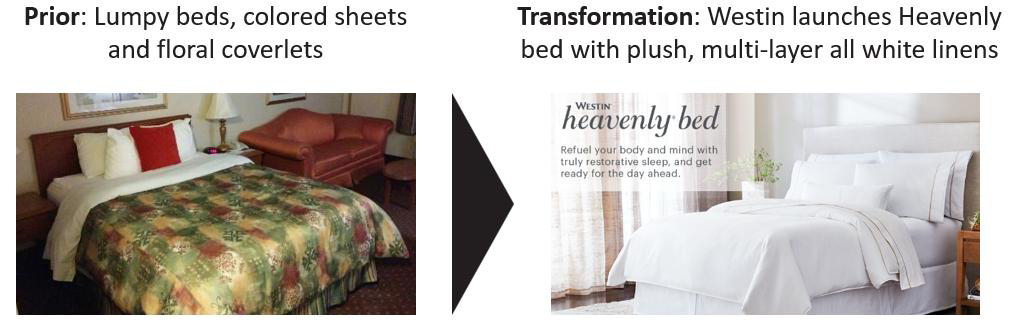
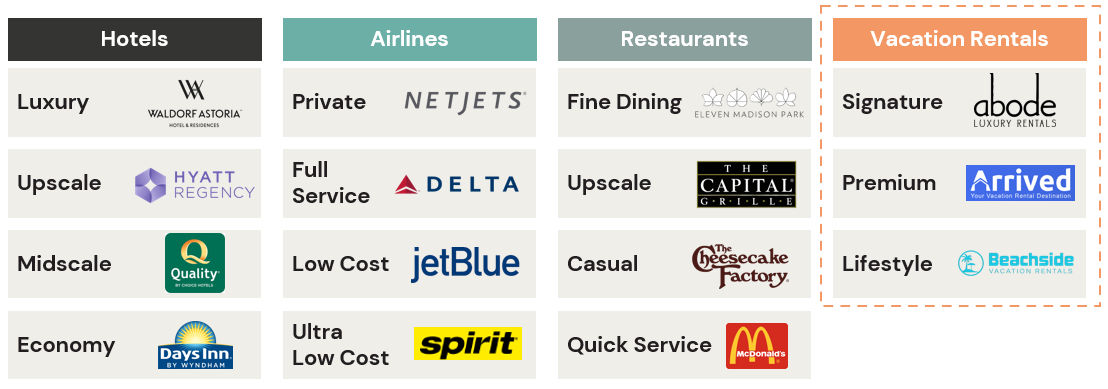
Our new research paper, Reasonable Hospitality: How Tiered Standards Create Predictability and Scalable Value, looks at what vacation rentals can learn from the industries that solved this problem before them. Hotels, restaurants, and airlines each grew explosively, each produced enormous variation in quality, and each answered with standards and recognizable tiers that let guests book with confidence.
Vacation rentals have lived through the growth. They have not yet built the second half of the story.
Read the full white paper
22 pages on standards, hospitality tiers, and the Predictability Dividend. By Ashley Ching and the Inhaven team, August 2026.
Download the paper (PDF)The inspection era, and how hotels ended it
The Federal-Aid Highway Act of 1956 financed the Interstate Highway System, affordable family cars did the rest, and roadside lodging exploded along the new corridors. The rapid increase in supply produced enormous variation. Families arrived at a motel, asked for the key, inspected the mattress and the bathroom, and only then decided whether to stay. The transaction depended on inspection rather than confidence.
The industry's answer was brands built on standards. In 1951, Kemmons Wilson took his family on a road trip to Washington DC and came home frustrated by the inconsistent, overpriced motels along the way. The first Holiday Inn opened the following year, and within sixteen years there were a thousand. Its 1970s slogan stated the philosophy outright: "The best surprise is no surprise."
Online travel agencies played the role the automobile once played, giving millions of homeowners access to travelers around the world. The pandemic and remote work played the role of the interstate highways. The combination produced an explosion of new supply with widely varying quality, and it revived an antiquated transaction experience. Guests scrutinize photo galleries and pore over reviews before committing. Today's listing inspection is the modern version of asking for the key to check the mattress.
What is Reasonable Hospitality?
Reasonable Hospitality is the framework that connects four stages. Objective standards establish an operating foundation. Those standards translate into hospitality tiers, a language of trust. The shared language aligns the stakeholders responsible for investment, operations, and distribution. That alignment creates what we call the Predictability Dividend, and when the promise repeats across many independent assets, the industry can scale.
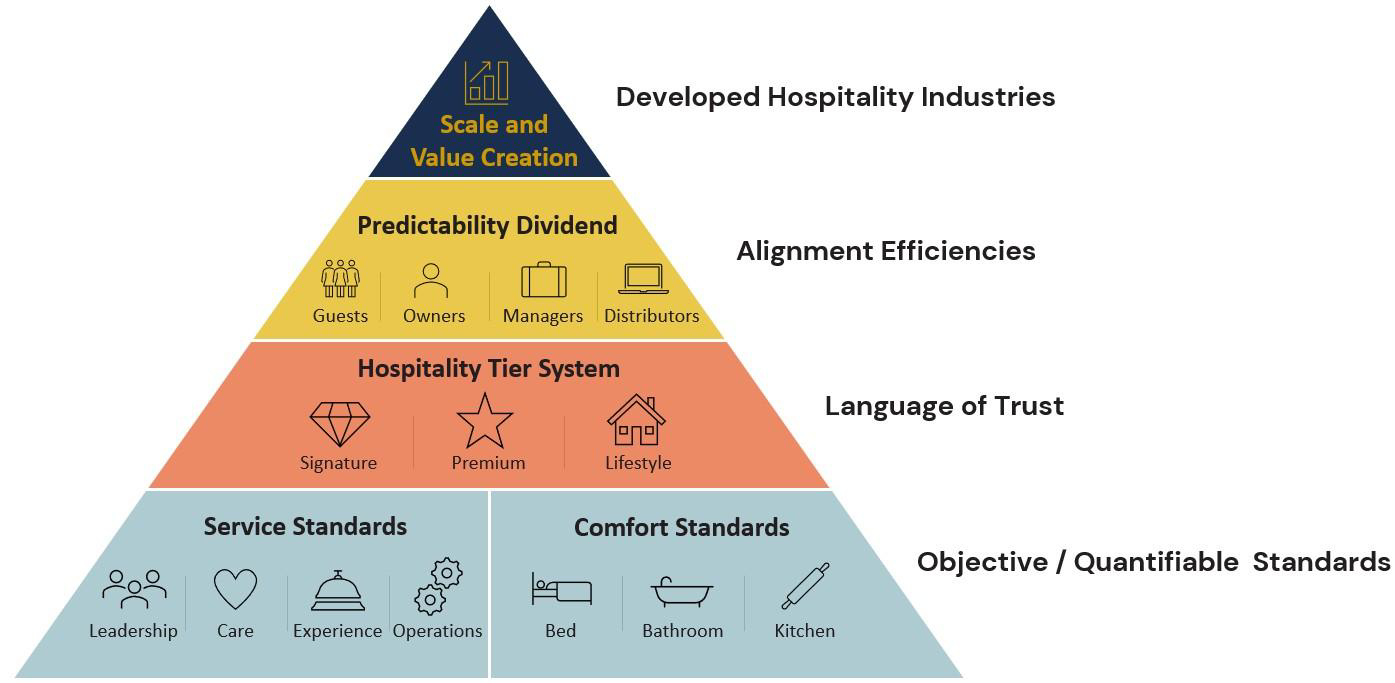
Standards
Objective, quantifiable requirements that let independent participants act consistently without renegotiating the operating model each time.
Hospitality tiers
A market-facing language of trust. Hotels have chain scales, airlines have cabin classes, restaurants have dining tiers.
Predictability Dividend
Recurring value paid to guests, owners, managers, and distribution partners once the promise becomes repeatable.
Scale and value
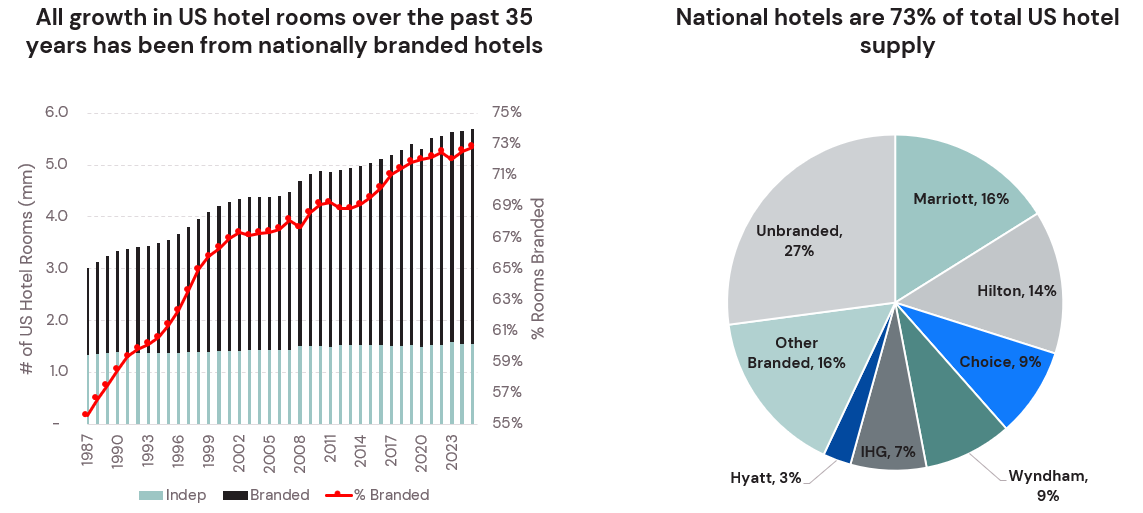
Since 1987, essentially all net room supply growth in the U.S. has occurred within branded systems. Independent rooms stayed broadly flat.
Service is the strongest determinant of a tier
Consumers often associate elevated hospitality with product quality, architecture, location, or price. Each contributes. Across hospitality industries, though, the most consistent single differentiator among tiers is the intensity of human service.
Hill Street Tai Hwa Pork Noodle in Singapore and Eleven Madison Park in New York have both received stars from The Michelin Guide, yet they sit at opposite ends of the restaurant spectrum. At Hill Street, one employee takes and distributes orders. A table at Eleven Madison Park may interact with up to nine service staff. The difference in price reflects more than ingredients or dinnerware. It reflects the amount of human attention devoted to the guest.
Physical product still matters. An economy property can offer an excellent bed, but it cannot sustain a luxury staffing model without giving up its profitability. Service quality is what sets the ceiling on the tier.
The Luxury Fallacy
Public discussion of hospitality dwells on its most exclusive experiences. The result is a durable misconception, the Luxury Fallacy, the belief that the most visible and aspirational hospitality is the universal model for the industry. Luxury properties account for roughly three percent of U.S. hotel rooms. Most guests purchase hospitality from all the other tiers.
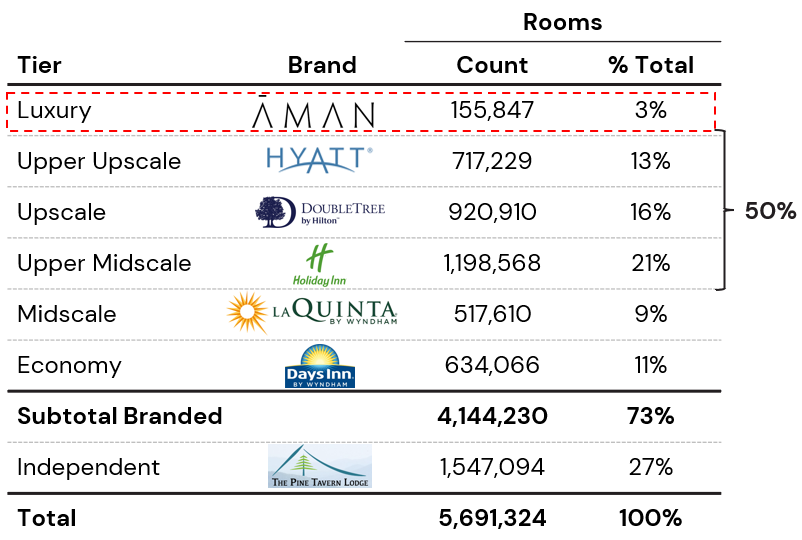
A developed framework has to recognize excellence at every tier. A $150 hotel room should not be judged against the staffing or the physical product of a $1,500 resort. It should be judged against the promise it made, the guest it was designed to serve, and how consistently it delivered.
Reviews cannot do this job alone
A review is retrospective. It records whether one guest believed a property met the expectations attached to their booking. A tier is prospective. It establishes what kind of experience the property is expected to deliver before anyone books. Without that forward promise, a market can accumulate enormous quantities of feedback and remain hard to interpret.
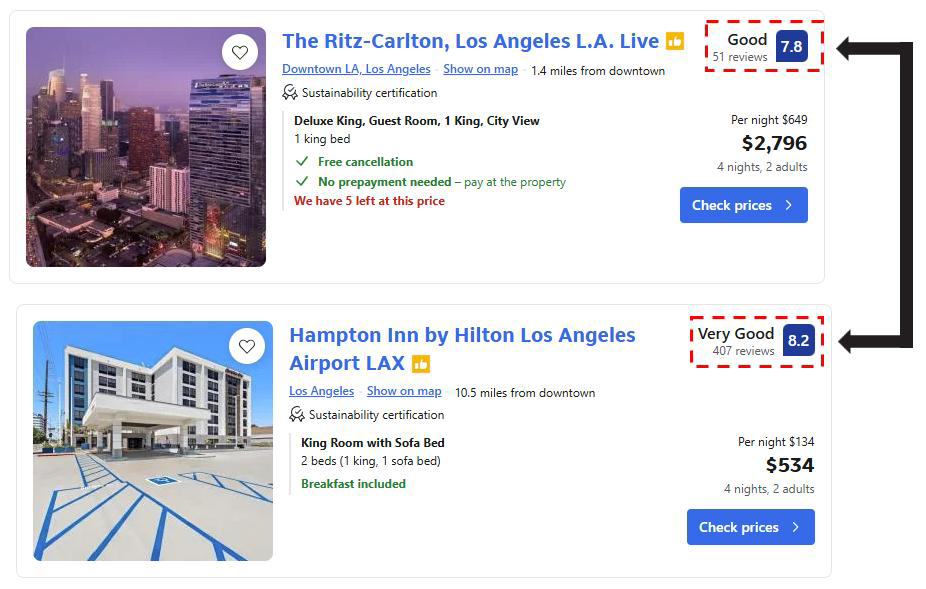
The Hampton Inn may have delivered exceptional value within a streamlined model, but the score does not say its guest experience exceeded the Ritz-Carlton's. Each property was evaluated against a different expectation. Vacation rental ratings offer even less context. Two homes can both be a "Guest Favorite" with perfect five star ratings when one is a large estate and the other a basic converted container.
Why vacation rental standards belong at the property manager level
Two attributes separate vacation rentals from traditional hospitality. Homes are multi-use assets, working as income-producing businesses while also serving as second homes, so owners pull in competing directions. And homes are rarely purpose-built, so layouts, fixtures, and furnishings reflect the taste of individual homeowners.
Hospitality standards have to be applied where control over the guest experience actually resides. Hilton dictates the room design for every Hampton Inn. Delta specifies the seating configuration of its aircraft. In vacation rentals, controlling the experience at the property level is impossible because every home is unique and every owner has different goals. Prior attempts at standards failed because they targeted the property. The right attachment point is the property manager, where executives are aligned on economic returns and where control over the guest experience sits.
Two dimensions: Service and Comfort
Service Standards define how the home is operated and how the guest is supported during the stay. Comfort Standards set expectations for the continued replenishment of furnishings in the bed, bathroom, and kitchen. Together they determine a single Hospitality Tier.
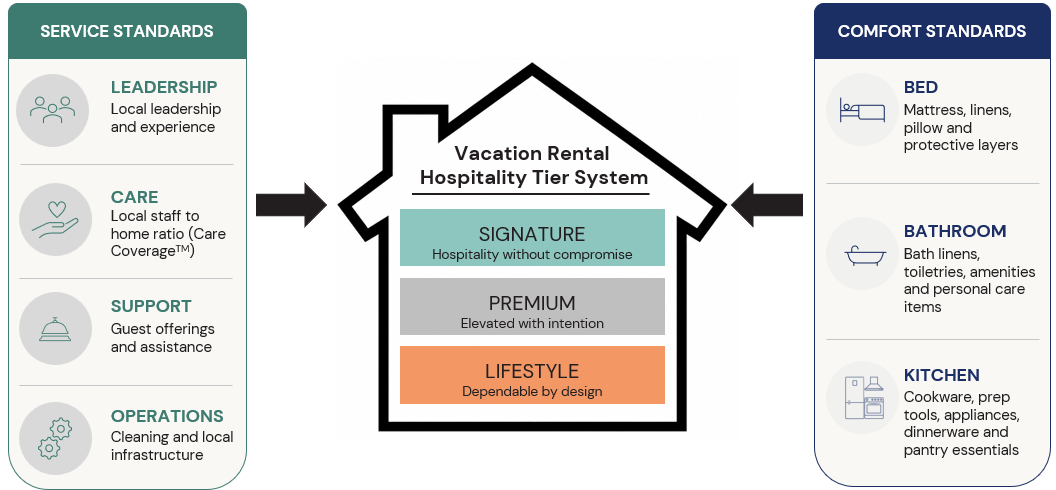
Service Standards
| Tier | Leadership | Care | Support | Operations |
|---|---|---|---|---|
| Signature | Local executive with significant experience | Care Coverage Ratio of 1 : 5 | Concierge service | Pre-arrival inspections and local office |
| Premium | Local executive presence | Care Coverage Ratio of 1 : 10 | Full service | Local office |
| Lifestyle | Centralized executives | Care Coverage Ratio of 1 : 15 | Digital first guest support | Remote infrastructure |
Hotels measure employees per room. Restaurants measure employees per table. Vacation rentals need a measure of their own. The Care Coverage Ratio counts local full-time employees relative to the number of homes managed.
It includes seasonal and maintenance staff, defines local personnel as those within a two-hour drive of the service market, and excludes 1099 contractor cleaning personnel, whose staffing tracks turnover levels. The framework does not assume more service is always better. It asks whether service capacity is sufficient for the promise being made.
Comfort Standards
Comfort Standards cover the three functional spaces that shape the foundation of a stay. Once guests have had a good night's rest, a refreshing shower, and a meal made in the kitchen, they are ready to appreciate everything that makes the home unique.
| Tier | Bed | Bathroom | Kitchen |
|---|---|---|---|
| Signature | Luxurious bedding for exceptional sleep | Spa-like amenities | Chef's kitchen to prepare a holiday meal |
| Premium | Elevated bedding for a great night of sleep | Refined amenities to embrace self-care | Well-equipped for home cooked comfort |
| Lifestyle | Essential bedding | Curated amenities with the essentials you need | Stocked to prepare a basic meal |
A home qualifies only for the highest tier at which both its Service Standards and its Comfort Standards are satisfied. Signature-level comfort with Premium-level service qualifies as Premium. The rule stops elevated furnishings from overstating the service experience, and stops high-touch service from masking an under-equipped home.
A common concern is that comfort standards will make rentals uniform, standardizing away what distinguishes a mountain lodge from a beach cottage. That confuses aesthetics with operating reality. Bed linens, towels, toiletries, cookware, dinnerware, and pillows are used constantly and get worn out, damaged, depleted, or removed. Replenishing them efficiently is what frees the living room, the dining room, and the outdoor space to be enjoyed as designed.
The Predictability Dividend
When a hospitality promise becomes recognizable and repeatable, it pays a recurring return across the whole ecosystem.
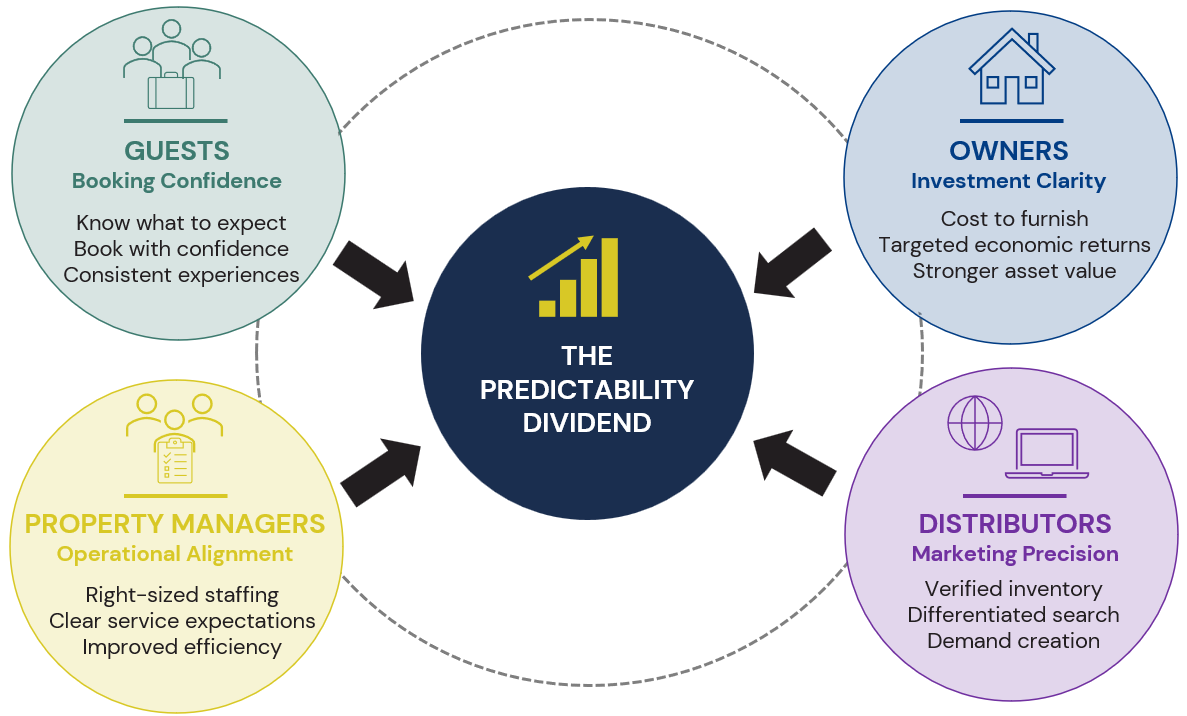
These dividends compound. Confident guests return, returning demand steadies operator economics, steadier economics justify owner investment, and verified investment gives brands and distribution partners more to promote. The hotel industry ran this flywheel for half a century.
Standards only work when they are verified
A tiered framework needs more than published specifications and guest reviews. Rather than auditing every home with an annual visit, the process combines property-manager qualification, purchasing visibility, on-site confirmation, and continuing quality assurance. Purchasing records show whether the defined comfort products are actually installed in the homes. On-site review of the management company confirms local leadership, personnel, services, and infrastructure.
Qualification recognizes continuing eligibility, not a permanent award. Products wear out, staffing changes, services evolve. Verification is what converts a Hospitality Tier from a marketing claim into a credible market signal.
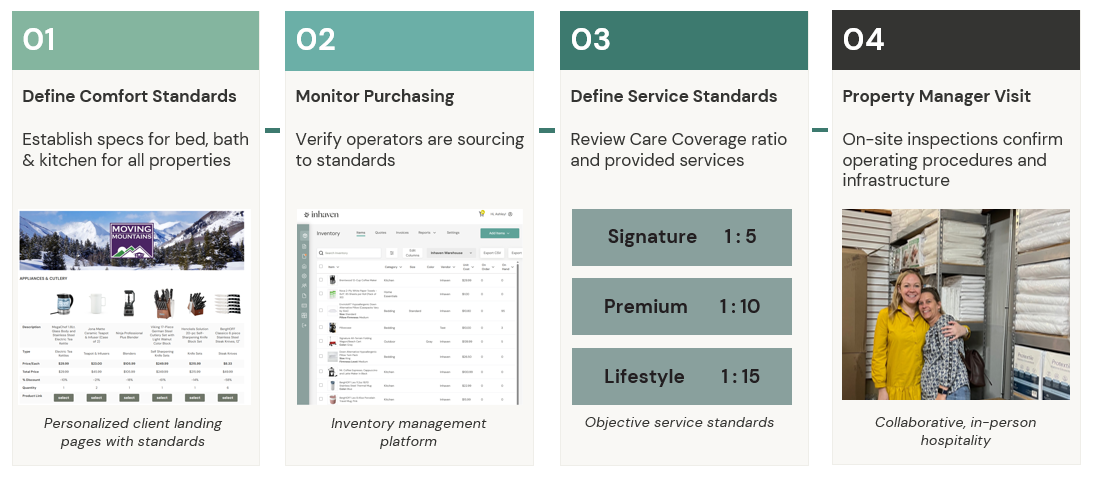
How a property manager gets qualified
The framework only matters if there is a practical way to enter it. Inhaven built the standards infrastructure that sits behind the tiers, so qualification does not require an annual inspection of every home in a portfolio.
Define your standards
Set your comfort specifications for bed, bath, and kitchen across the portfolio, and document the service model behind them.
Source to the standard
Purchase against those specifications. Purchasing records become the evidence that the defined products are actually in the homes.
Confirm your service level
Review your Care Coverage Ratio, local leadership, guest offerings, and operating infrastructure against the Service Standards rubric.
Maintain the tier
Qualification is continuing eligibility, not a permanent award. Replenishment and staffing are reviewed as they change.
Most managers already do the first three informally. What is usually missing is the record that turns those decisions into a claim a guest, an owner, or a distribution partner can trust.
Start with one category. Pick the bed, standardize it across every home at a single specification, and put the purchasing on one record. That one move gives you a defensible Comfort Standard and a repeatable replenishment plan. Write to info@inhaven.com and we will help you map your portfolio to a tier.
What this changes for property managers
The framework addresses the industry's greatest structural shortcoming, its overreliance on guest reviews. In hotels, restaurants, and airlines, brand standards and quality tiers communicate the offering before a purchase is made, and reviews help the guest judge whether the operator lived up to it. In vacation rentals, the absence of standards forces the review score to define the product and evaluate its performance at the same time.
That creates an environment where anything less than a 5-star review is treated as failure, and it leaves managers exposed to unreasonable refund demands, fraudulent ratings, and extortionary tactics. Shared standards restore the balance. The property manager defines their service and comfort standards up front, and the guest evaluates execution afterward. Reviews stay valuable, but they stop carrying the whole burden of explaining the product.
This does not require unanimity. Roughly 73% of the U.S. hotel market operates with branded systems, and in Europe the figure is closer to 36%. Independent hotels remain integral to lodging worldwide, and chain scales still provided a baseline of quality that elevated the entire market.
The foundation already exists. The U.S. has approximately 25,000 professional vacation rental management companies led by experienced operators embedded in their communities, and many have already built service and comfort standards to drive operational efficiency. The opportunity is to aggregate and amplify those standards into a shared language that makes high-quality management visible to the broader market.
Hospitality creates memories. Standards build industries.
Reasonable Hospitality: How Tiered Standards Create Predictability and Scalable Value
The complete 22-page paper, with all 22 figures and sources. Questions about applying the framework to your portfolio? Write to info@inhaven.com.
Download the paper (PDF)