

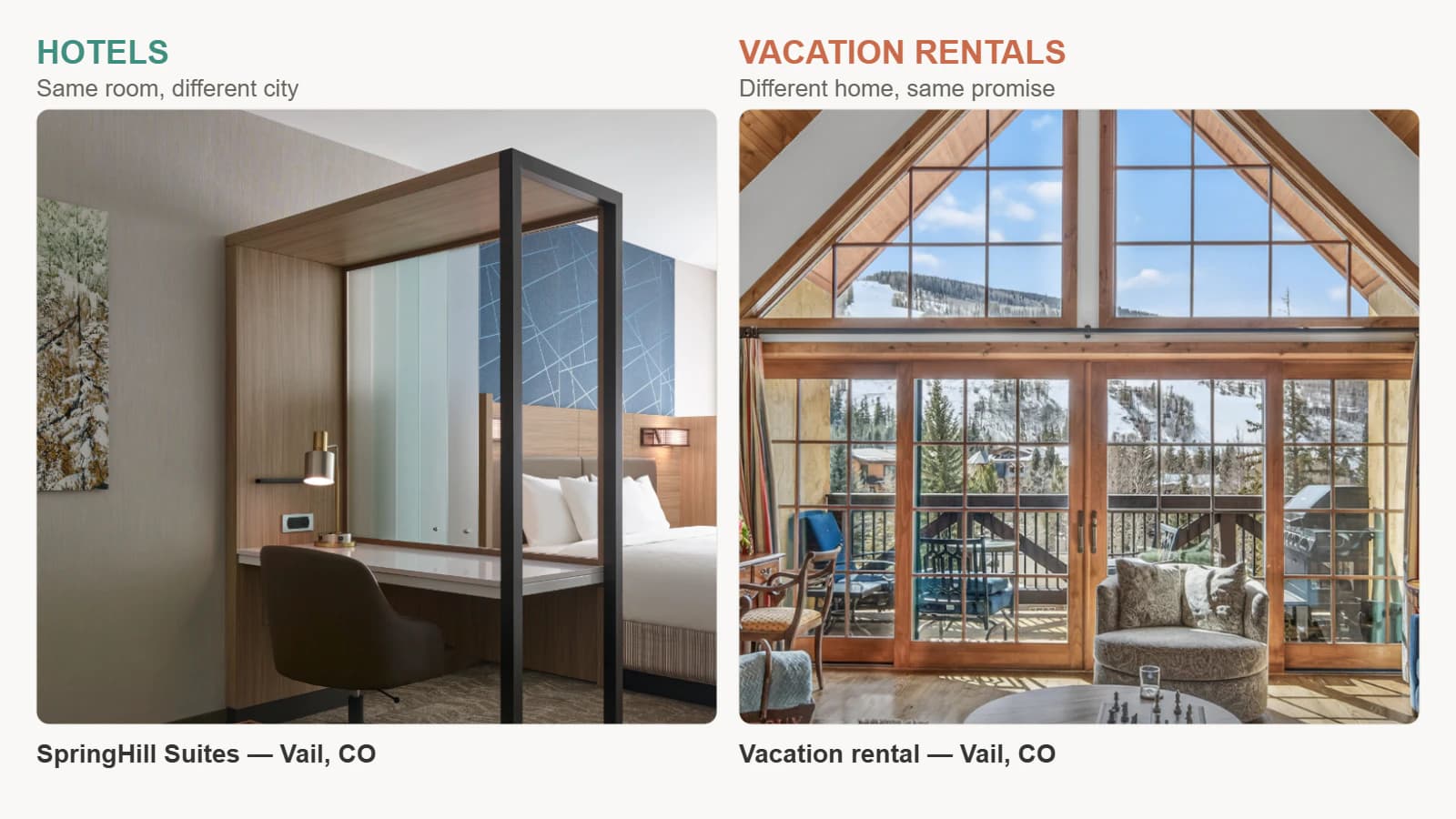
Standardize the Hospitality, Not the Home
If we standardize vacation rentals, do we risk making every home feel the same? It is a question we have heard repeatedly since publishing our Reasonable Hospitality research, and it is an important one.
Part of the reason people choose vacation rentals is because they do not want every stay to look the same. A mountain home in Vail should feel like the mountains. A home in Hilton Head should reflect Lowcountry living. A Southern California rental should be able to embrace indoor-outdoor living, local architecture and the personality of its owner.
That individuality is not something the vacation rental industry needs to fix. It is one of the category's greatest strengths. But individuality does not have to mean unpredictability.
What hotels standardized
Put three SpringHill Suites guest rooms side by side in Hilton Head, Vail and Southern California and something becomes obvious very quickly: despite being in completely different destinations, the rooms look and feel remarkably similar. That is intentional.
Hotel brands spent decades creating consistency across properties. A guest booking a familiar brand in a new destination has a reasonable idea of what the room will look like, how the bed will feel, what will be in the bathroom and what level of service will be available. That predictability helped hotels create trust at enormous scale.
But the lesson for vacation rentals is not that we should recreate the same room thousands of times. The lesson is that guests value knowing what they can count on.
Vacation rentals have a different advantage
Now put three vacation rentals from those same markets next to each other. The contrast is exactly what makes the category special.
In Hilton Head, you might find a screened porch surrounded by palms and live oaks. In Vail, a great room with timber beams, a stone fireplace and mountain views. In Southern California, glass doors may disappear into the walls and turn the living room into an outdoor space. The home helps tell the story of the destination.
Why would we want to standardize that away? We shouldn't. What we should ask instead is which parts of the experience benefit from individuality and which parts benefit from certainty.
Guests don't want every part of a stay to be unique
There are parts of a vacation rental where surprise is wonderful. The architecture. The living room. The artwork. The deck. The pool. The view. The neighborhood.
Then there are the basics. Guests generally do not arrive hoping to discover whether the mattress will be comfortable. They do not want to guess whether there will be enough towels, whether the kitchen has the equipment needed to prepare a meal, or whether someone will respond when something goes wrong. At the end of the day, hospitality still has to help people sleep, bathe and eat comfortably.
That is why the Reasonable Hospitality framework separates Service Standards from Comfort Standards. Service Standards focus on how the guest is supported and how the home is operated. Comfort Standards focus intentionally on the bed, bathroom and kitchen, the functional areas where reliability matters most. The scope is deliberately limited: create certainty where inconsistency creates the most friction, while leaving the architecture, design and character of the home alone.
Standards can actually protect individuality
This distinction matters because many of the products covered by Comfort Standards are also the highest-velocity products in a vacation rental. Sheets get stained. Towels disappear. Toiletries are consumed. Glassware breaks. Cookware wears out. Pillows and bedding eventually need to be replaced.
These items are going to be replenished whether a property manager has a standard or not. Without standards, replacement often happens reactively. Someone buys the closest available towel, substitutes a different sheet or replaces broken kitchenware with whatever can be found quickly. Over time, the guest experience becomes less consistent and operations become harder to manage.
With standards, those decisions are made in advance. Owners know what belongs in the home. Property managers know what to purchase and replenish. Housekeeping and operations teams know what should be there for the next guest.
And the unique parts of the home can remain exactly that: unique. Our research intentionally separates these frequently replaced operating products from the living rooms, dining rooms, family rooms and outdoor spaces that give a home its character.
The standard belongs behind the home
This is also why we believe vacation rental standards should attach primarily to the property manager, not dictate the design of every individual property.
Hotels are built as commercial assets. A hotel brand can specify the furniture, layout, fixtures and finishes throughout the building. Vacation rentals are different. They are individually owned homes, often designed for both personal and commercial use. Owners have different tastes, different investment goals and different reasons for owning the property. Trying to make every home conform to a hotel-style physical standard fights against the structure of the category itself.
Property managers, however, control many of the things that determine the hospitality experience: service, staffing, operating processes, local infrastructure and the replenishment of high-velocity products in the bed, bath and kitchen. That is where consistency becomes both possible and valuable.
Predictability does not require sameness
Vacation rentals do not need to become hotels to build greater guest trust. In fact, they have an opportunity to offer something arguably more compelling: the personality and sense of place of an individual home, combined with a hospitality experience guests can understand before they book.
Imagine knowing that your Vail home will feel nothing like your Hilton Head home, but knowing both will deliver the level of comfort, cleanliness and service you expected. That is the opportunity.
Different home. Same expectation.
The goal of standards should never be to make vacation rentals look the same. It should be to make the hospitality behind them dependable.
Standardize the hospitality. Not the home.
Reasonable Hospitality: How Tiered Standards Create Predictability and Scalable Value
For more on how Service Standards, Comfort Standards and hospitality tiers can create greater predictability across vacation rentals, read the full research.
Read the research